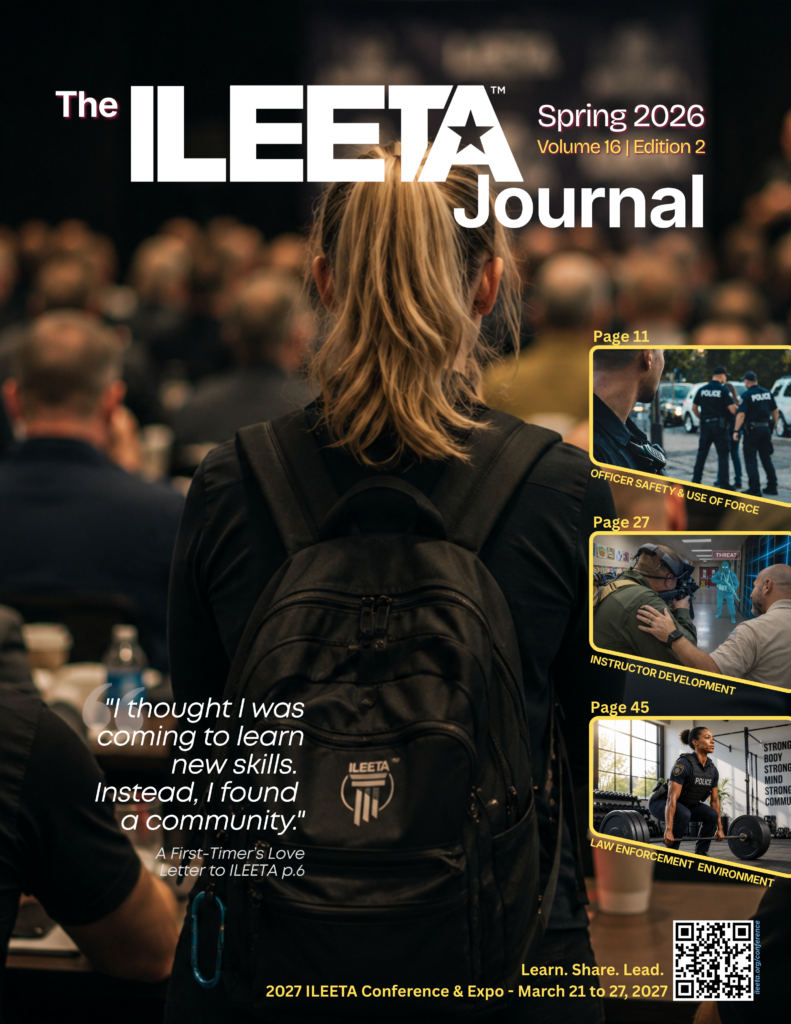
The ILEETA Journal
The ILEETA Journal is the official publication of the International Law Enforcement Educators and Trainers Association (ILEETA). It is designed for law enforcement educators, trainers, and professionals, providing them with relevant information on best practices, innovations, and developments in law enforcement training and leadership. The journal covers a wide range of topics such as tactical skills, use-of-force training, leadership development, wellness, and mental health. Articles are typically written by experienced law enforcement trainers and experts, offering practical insights, research, and strategies to help improve the effectiveness of law enforcement agencies and their personnel.
The journal serves as a resource for enhancing training programs and developing the next generation of law enforcement officers, while also focusing on the well-being and professionalism of those currently serving.
OFFICER SAFETY AND USE OF FORCE
Officer safety begins long before an incident unfolds. This section explores evidence-based approaches to use of force, tactical decision-making, firearms training, emerging technologies, and performance under stress. Drawing from research, operational experience, and practical instruction, these articles challenge conventional thinking while providing actionable strategies for law enforcement trainers. Whether you’re refining scenario-based training, evaluating new equipment, or strengthening officer judgment, you’ll find ideas designed to improve performance when lives are on the line.
Virtual Reality as a Targeted Tool: Promise, Limits, and Judgment in Law Enforcement Training | Dr. Lon Bartel
Virtual reality (VR), augmented reality (AR), and mixed reality (MR) continue to reshape law enforcement training, but where do these technologies truly belong? Dr. Lon Bartel examines the strengths and limitations of extended reality (XR), demonstrating that its value depends on matching the technology to specific training objectives rather than treating it as a universal solution. From decision-making under stress and scenario-based training to motor skill development, legal instruction, and interpersonal communication, he explains where immersive technology enhances officer performance and where traditional methods remain superior. Most importantly, Bartel reinforces that technology will never replace the instructor. Effective police training still depends on sound instructional design, thoughtful debriefing, and experienced trainers who know how to match the right tool to the right learning objective. A valuable resource for instructors evaluating how emerging technologies can strengthen, rather than replace, evidence-based law enforcement training.
The Architecture Behind Decision Making | Andrea Bogiatto
Every critical incident begins long before the decision itself. Andrea Bogiatto explores the behavioral architecture behind law enforcement decision-making, arguing that officers under stress rely less on conscious thought than on deeply ingrained habits. Building on concepts such as scenario-based training, habit formation, and decision latency, he presents a practical framework for identifying ineffective behavioral patterns, replacing them through focused practice, and measuring improvement over time. Rather than treating mistakes as failures, Bogiatto demonstrates how instructors can use controlled stress, structured observation, and deliberate repetition to build stronger operational performance. A practical resource for law enforcement trainers, police instructors, and instructor development professionals seeking to improve decision-making, resilience, and performance where it matters most: on the next shift.
God’s Eye Fallacy | Michael Brave
Video evidence is an invaluable investigative tool, but it is not an all-seeing witness. Michael Brave examines the “God’s Eye Fallacy,” the mistaken belief that body-worn camera footage or other video recordings provide a complete and objective account of a law enforcement use of force incident. Drawing on constitutional law, landmark U.S. Supreme Court decisions, and current research on perception and body-worn cameras, he explains why officer decision-making must be evaluated from the perspective of a reasonable officer facing rapidly evolving circumstances, not through hindsight or slow-motion video analysis. This article provides an important legal and instructional framework for law enforcement trainers, use of force instructors, investigators, and supervisors responsible for preparing officers to understand, articulate, and defend their actions under constitutional standards.
Three Phases. One Job. Is Your Training Keeping Up? | Colonel Dr. Wendy Dorrestijn
Real-world incidents do not begin when officers arrive on scene, and effective law enforcement training should not either. Drawing on extensive research involving nearly 2,000 police and military officers, Colonel Dr. Wendy Dorrestijn demonstrates that every critical incident unfolds in three distinct phases: pre-incident, action, and post-incident. Each phase develops a different type of learning, cognitive preparation, procedural execution, and reflective growth, yet many scenario-based training programs focus almost exclusively on the action itself. Dorrestijn argues that representative training must incorporate planning, decision-making, realistic execution, and structured debriefing to build true officer performance and decision-making under stress. An essential read for law enforcement trainers, academy instructors, and curriculum developers committed to designing training that reflects the realities officers face on every shift.
The Use of Force in Security: A Perspective Based on Traditional Chinese Wisdom | Fabio Gomes
How do we move beyond viewing force as simply a matter of escalation? Fabio Gomes explores use of force through the lens of Classical Chinese strategic thought, challenging law enforcement trainers and security professionals to see force not as an automatic response, but as one tool among many. Drawing on the teachings of Sun Tzu, traditional martial arts, and real-world examples, he emphasizes situational awareness, adaptability, and human judgment over rigid adherence to prescribed models. Gomes argues that effective decision-making begins with understanding the context rather than imposing predetermined actions, encouraging instructors to develop officers who respond with precision, restraint, and purpose. A thought-provoking perspective for use of force instructors, leadership development, and anyone committed to improving decision-making in dynamic operational environments.
The Use of Force in Security: A Perspective Based on Traditional Chinese Wisdom | Fabio Gomes
How do we move beyond viewing force as simply a matter of escalation? Fabio Gomes explores use of force through the lens of Classical Chinese strategic thought, challenging law enforcement trainers and security professionals to see force not as an automatic response, but as one tool among many. Drawing on the teachings of Sun Tzu, traditional martial arts, and real-world examples, he emphasizes situational awareness, adaptability, and human judgment over rigid adherence to prescribed models. Gomes argues that effective decision-making begins with understanding the context rather than imposing predetermined actions, encouraging instructors to develop officers who respond with precision, restraint, and purpose. A thought-provoking perspective for use of force instructors, leadership development, and anyone committed to improving decision-making in dynamic operational environments.
The Learning Loop: A Practical Framework for Training That Transfers | Jeff Johnsgaard
Jeff Johnsgaard introduces the Learning Loop, a practical coaching framework that helps law enforcement trainers improve decision-making under pressure by focusing on how officers perceive, interpret, decide, and adapt during rapidly evolving encounters. Rather than correcting actions alone, Johnsgaard encourages instructors to uncover why officers made those decisions through purposeful questioning and structured debriefs. By shifting from performance correction to performance understanding, trainers can strengthen scenario-based training, accelerate skill transfer, and develop officers who think, adapt, and perform more effectively in real-world situations.
Pistol-Mounted Optics Conversion: Our Experience | Tom Snelling
Tom Snelling shares his agency’s successful transition to pistol-mounted optics (PMOs), offering practical lessons for law enforcement firearms instructors planning similar conversions. From classroom preparation and zeroing procedures to presentation, live-fire drills, and low-light training, he outlines the techniques that helped officers build confidence and proficiency. Snelling emphasizes that while red-dot optics cannot replace solid shooting fundamentals, they can significantly improve performance when paired with realistic, progressive training. His experience provides a practical roadmap for agencies seeking to implement PMOs while avoiding common training pitfalls.
INSTRUCTOR DEVELOPMENT
Great instructors are developed, not simply certified. This section examines the science and art of effective law enforcement training, from adult learning principles and instructional design to coaching, mentorship, artificial intelligence, and scenario-based instruction. These articles provide practical, evidence-based strategies to improve retention, decision-making, and long-term skill transfer while helping trainers build engaging, defensible, and measurable learning experiences that prepare officers for the realities of today’s profession.
Rethinking the AI Productivity Promise | Kerry Avery
Kerry Avery takes a practical look at artificial intelligence in instructional design, challenging the assumption that AI automatically saves time. Drawing on recent research, she explains how productivity gains are often offset by the time required to verify, revise, and correct AI-generated content. Avery argues that AI excels at bounded content creation but cannot replace the analytical judgment required for effective training design, learner analysis, or curriculum development. Her message to law enforcement trainers is clear: use AI as a tool for content production, not as a substitute for instructional expertise, and focus on thoughtful task decomposition to achieve meaningful productivity gains.
Preventing Confidence Collapse in Scenario-Based Training | Richard Caito
Richard Caito examines how scenario-based training must evolve to effectively prepare today’s recruits without lowering standards. Drawing on generational differences, learning science, and the Yerkes-Dodson Law, he argues that instructors should create learning while role players create stress. Rather than relying on yelling or humiliation, Caito advocates for realistic scenarios, constructive debriefs, and targeted feedback that build confidence, improve decision-making, and strengthen law enforcement training outcomes. His practical strategies help instructors develop resilient officers who can perform under pressure while maintaining psychological safety and long-term learning.
Create Next Level Training Using Adult Learning Concepts: It Begins in the Classroom | Capt. Mark Candies (Ret.)
Mark Candies demonstrates how adult learning principles transform law enforcement training from passive instruction into meaningful skill development. He explains that effective training begins with clear performance objectives, purposeful lesson plans, and a progression from knowledge to skills to real-world application. Through collaborative learning, case studies, demonstrations, role play, and constructive feedback, instructors can create engaging classroom experiences that improve retention, decision-making, and performance. Candies reminds trainers that successful instruction is not about adding more activities, but about intentionally designing learning that prepares officers for the realities of the street.
Teach to Retain: Turning Officers into Instructors for Better Learning | Dan Fraser
Dan Fraser explores the Protégé Effect, research showing that learners retain knowledge and skills more effectively when they expect to teach others. He explains how incorporating simple teach-back exercises into law enforcement training improves retention, strengthens communication skills, builds confidence, and exposes gaps in understanding. By shifting students from passive learners to active instructors, trainers can enhance long-term learning and increase the likelihood that critical knowledge and skills transfer successfully to real-world policing.
Certification Is Not Mastery: Why Instructor Development Is Broken | Josh Logan
Josh Logan challenges the profession’s reliance on instructor certification as proof of competence, arguing that true law enforcement instructor development requires far more than completing a course. He identifies three pillars of mastery: technical performance, teaching ability, and diagnostic coaching skills. Logan calls for structured mentorship, ongoing professional development, and accountability to create instructors who can build measurable, defensible performance in others. His message is clear: certification establishes a baseline, but mastery is earned through continual growth, and the quality of instructor development directly impacts officer performance, agency liability, and public trust.
Packing the Parachute | Derek Miller
Drawing on the true story of Navy Captain Charles Plumb, Derek Miller reminds law enforcement trainers that every lesson they teach may one day save an officer’s life. Whether covering high-risk tactics or routine in-service topics, instructors are “packing the parachute” their students may someday rely upon. Miller challenges trainers to approach every class with purpose, precision, and a servant’s heart, recognizing that they may never know when their preparation prevents tragedy. The article is a powerful reminder that excellence in training is measured not by recognition, but by the unseen moments when officers safely apply what they have learned.
The Three Things Evidence-Based Law Enforcement Training Must Do | Jennifer Kerwin
Jennifer Kerwin outlines three essential principles for evidence-based law enforcement training: respect officers’ experience, strengthen decision-making under pressure, and provide safe opportunities to practice judgment before it is needed in the field. She explains how adult learning principles, realistic scenarios, and thoughtful use of eLearning can improve engagement, retention, and operational readiness. Kerwin emphasizes that effective training is not simply about delivering information, but about preparing officers to think critically, adapt to evolving situations, and make sound decisions when the stakes are highest.
The Illusion of Instructor Certification | Ian Tindale
Ian Tindale challenges the common assumption that earning an instructor certification is the same as becoming an effective trainer. Drawing on decades of experience, he argues that short certification courses validate only a narrow technical standard, not the broader skills required to teach adults, manage safety, design assessments, or develop operational competence. Tindale encourages law enforcement instructors to view certification as the beginning of their journey, embracing continuous professional development, mentorship, and lifelong learning to become true educators who elevate both their students and the profession.
LAW ENFORCEMENT ENVIRONMENT
The profession continues to evolve, and effective training must evolve with it. This section explores leadership, wellness, resilience, emotional intelligence, evidence-based policing, fire investigation, and the cultural factors shaping today’s law enforcement environment. These articles encourage instructors and leaders to think beyond tactics, examining the human side of policing while offering practical ideas to strengthen officer readiness, organizational culture, professional development, and long-term career sustainability.
Priming Performance: How Instructional Language Shapes Officer Response | Jamie Blume
Drawing on his experiences as both a Marine and a police captain, Jamie Blume explores how the language instructors use can shape law enforcement officer mindset and decision-making. He argues that labels and terminology influence how officers perceive potential threats, affecting their preparedness for high-risk encounters. Rather than minimizing adversaries through dismissive language, Blume encourages trainers to prime officers for the realities of confronting capable and determined threats. His message is a reminder that effective law enforcement training begins with deliberate communication, because the words instructors choose today can influence performance when lives are on the line.
Smart, Not Soft: The Invisible EQ Shield in Corrections | Michael Cantrell
Michael Cantrell argues that emotional intelligence (EQ) is an essential component of corrections officer safety, not a “soft skill.” Drawing on research and nearly three decades of experience, he explains how self-awareness, self-management, social awareness, and relationship management help officers recognize stress, regulate emotions, strengthen teamwork, and prevent burnout. Cantrell encourages agencies to view EQ as psychological armor that improves decision-making, resilience, and operational effectiveness, making officers better equipped to navigate the daily demands of corrections while protecting both themselves and those they serve.
Part 4: Igniting Knowledge, Practical Strategies for Teaching Fire Investigation to Law Enforcement | Jason Dunn
Jason Dunn concludes his four-part series by providing practical strategies for teaching fire investigation to law enforcement officers. He encourages instructors to incorporate fire investigation into existing curricula through scenario-based training, case studies, tabletop exercises, cross-training with fire services, and expert guest speakers. Dunn emphasizes that the objective is not to create fire investigators, but to develop observant officers who can recognize arson indicators, preserve evidence, collaborate effectively with fire personnel, and contribute to successful investigations while maintaining officer safety.
You Check Your Gear Before Every Shift. When Did You Last Check Your Heart? | Brian Hill
Brian Hill shares his personal experience with atrial fibrillation to deliver a powerful reminder that an officer’s most important piece of equipment is their own health. He examines the hidden cardiovascular risks associated with law enforcement, challenges the culture of ignoring warning signs, and urges instructors to lead by example through regular cardiac screenings and honest conversations about wellness. Hill reminds trainers that modeling healthy habits is as important as teaching tactical skills, because the people we train are always watching.
From the Garden: Lessons in Resilience, Perseverance, and Finding Your Release | Kim Schlau
Drawing from the story of a peony bush that flourished years after being crushed, Kim Schlau reflects on the resilience required in law enforcement. She explores how recovery is built through small, consistent steps, meaningful relationships, and healthy outlets beyond the badge. Using gardening as a metaphor for renewal, Schlau encourages officers to find purposeful pursuits that restore perspective, reduce stress, and provide tangible accomplishment. Her message is simple: resilience is cultivated over time, and every officer needs something that helps them grow beyond the demands of the profession.
Leadership in a Recruit Training Environment: Building Teams that Produce Professional Officers | Travis Stansell
Travis Stansell explores how intentional leadership in the academy shapes the future of the profession. He argues that effective recruit training is built on servant leadership, leading by example, meaningful mentorship, and cohesive instructor teams rather than intimidation or fear-based methods. By fostering trust, professionalism, accountability, and consistent standards across the instructional staff, agencies can develop confident, capable officers whose leadership and decision-making continue to grow long after they leave the academy.
Training for Reality: Teaching Evidence-Based Policing in a Changed Environment | Dillon Tittle
Dillon Tittle examines the growing gap between modern policing research and the way officers are trained. He argues that evidence-based strategies such as problem-oriented policing, community policing, hot spots policing, disorder policing, data-driven policing, and proactive policing are most effective when taught as an integrated system rather than as isolated concepts. By helping officers understand how these complementary models work together, instructors can build confidence, improve decision-making, strengthen community legitimacy, and prepare officers to police proactively within today’s complex operational environment.
BOOK REVIEWS
The best leaders and instructors never stop learning. Our book review section highlights resources that support professional growth in leadership, criminal justice, training, and emerging technology. Each review provides practical insights into what readers can expect, why the material matters, and how it can improve leadership, instruction, and operational effectiveness. Whether you’re building your professional library or looking for your next great read, these reviews point you toward resources worth your time.
Book Review: Common Sense Law Enforcement Leadership | Reviewed by Brent Colbert
This review highlights Common Sense Law Enforcement Leadership by Gerald W. Garner as a practical guide for leaders at every level of policing. The reviewer praises the book’s accessible, bite-sized format and its emphasis on communication, media relations, sound decision-making, and servant leadership. Rather than presenting leadership as theory, Garner provides actionable guidance that frontline supervisors and executives can apply immediately. The reviewer concludes that this comprehensive resource is an outstanding investment for anyone committed to becoming a more effective law enforcement leader, rating it a perfect 10 out of 10.
Book Review: Criminal Justice Technology in the 21st Century | Reviewed by Ben Wallace
Ben Wallace reviews Laura J. Moriarty’s Criminal Justice Technology in the 21st Century as a comprehensive reference for trainers, educators, and public safety professionals seeking to understand the expanding role of technology in modern criminal justice. Covering topics from patrol operations and communications to corrections, forensics, surveillance, and emerging technologies, the book provides practical context and extensive references for continued learning. Wallace particularly values its relevance to multi-agency training and interoperability, recommending it as an excellent reference resource to revisit over time rather than a book to read straight through.
AI Transparency: The article summaries presented on this page were generated with the assistance of artificial intelligence based on the authors’ original work and were reviewed and edited by the ILEETA editorial team prior to publication.
The ILEETA Journal is a quarterly publication of the International Law Enforcement Educators and Trainers Association (ILEETA), aimed at providing a platform for criminal justice professionals, primarily law enforcement trainers, to exchange information on training-related topics. It features articles, editorials, product reviews, and columns that meet stringent criteria for relevance, factual accuracy, and readability. Submissions are required in Microsoft Word format and should adhere to specific writing styles and grammar guidelines. The Journal ensures that all articles are edited for clarity and length and does not accept content promoting products or services.
The ILEETA Journal is the premier resource for cutting-edge insights and best practices in law enforcement education and training. We invite you to contribute your expertise and experiences by submitting an article. Share your knowledge, inspire your peers, and help advance the field. Ready to make an impact? Click here for submission guidelines and become a valued voice in our community.